
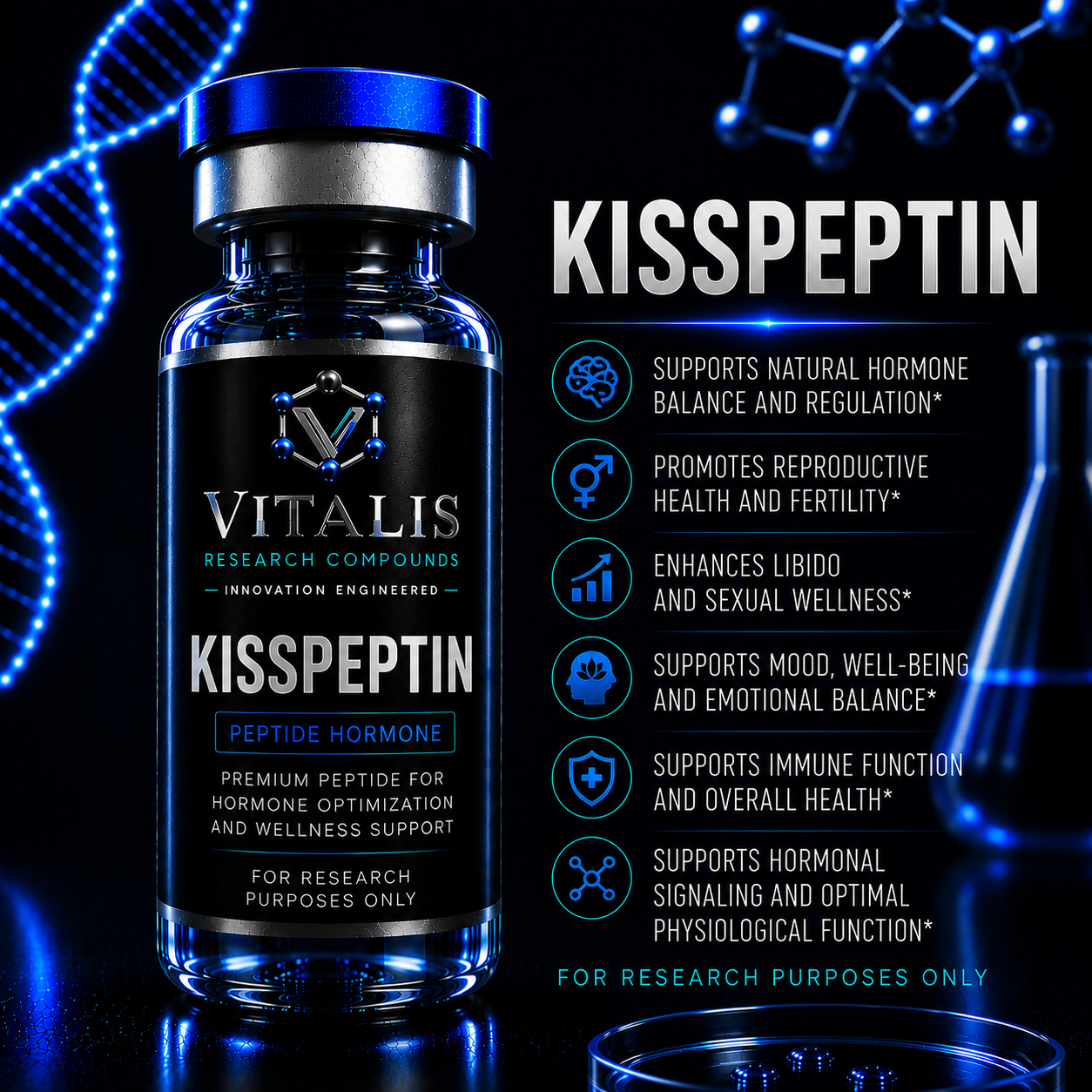
KiSS-1 Derived Peptide / GPR54 Agonist
Kisspeptin
Kisspeptin (KiSS-1 derived peptide) is an endogenous neuropeptide encoded by the KISS1 gene that acts as the primary activator of the hypothalamic-pituitary-gonadal (HPG) axis. It binds GPR54 (KISS1R) receptors on GnRH neurons, triggering pulsatile GnRH release and downstream LH and FSH secretion. Preclinical and clinical research has studied its role in puberty onset, reproductive cyclicity, fertility regulation, and hypogonadism. It is a key research tool in reproductive endocrinology, HPG axis biology, and neuroendocrine research. Multiple isoforms (Kisspeptin-10, -13, -14, -54) have been characterized.
Research Benefits
Key Research Applications
Documented areas of investigation based on peer-reviewed preclinical and clinical literature. For research reference only.
Melanocortin Activation
Acts via central melanocortin receptor pathways distinct from peripheral mechanisms.
CNS-Mediated Pathways
Studied for hypothalamic signaling effects in preclinical arousal and desire research.
Receptor Selectivity
Characterized binding profiles across melanocortin receptor subtypes (MC1R–MC5R).
Clinical Research Base
Supported by preclinical and clinical research with FDA-approved analogs.
Literature
Research Highlights
Primary GPR54-mediated GnRH pulse trigger — master regulator of the HPG axis (Seminara et al., 2003)
LH surge induction studied in rodent and primate reproductive cycle models
Puberty onset regulation via hypothalamic kisspeptin neuron activation in developmental studies
Hypogonadism research tool for dissecting central vs. peripheral reproductive axis defects
Specifications
Technical Data
Molecular Weight
1302.5 g/mol (Kisspeptin-10)
Sequence / Structure
Tyr-Asn-Trp-Asn-Ser-Phe-Gly-Leu-Arg-Phe-NH₂ (Kisspeptin-10)
Storage Conditions
Lyophilized: −20°C, stable 24 months. Reconstituted: 4°C, use within 28 days.
Solubility
Soluble in water at ≥1 mg/mL
HPLC Purity
Verified — Batch VRC-KSP-2407
Testing Lab
Intertek Pharmaceutical Services · Jul 2026
Research Areas
Ready to Order Kisspeptin?
Kisspeptin is currently in stock. View pricing, sizes, and the full Certificate of Analysis on the product page.
For Research Purposes Only. Kisspeptin is sold exclusively for in vitro laboratory research. Not for human consumption, diagnostic, therapeutic, or veterinary use. Research highlights are summaries of published preclinical and clinical studies and do not constitute medical advice or claims of efficacy. See our Research Use Disclaimer.